
Could we finally cure the incurable?
Discovery chemistry advances through evidence-backed decisions
Where the next move is tested
A high-stakes chemistry question becomes a program when the next move can survive review.
In Reaxys, chemists work across indexed literature and patents, bioactivity and target data, route precedents, starting-material availability, drawn structures and substructure search, then leave with the source trail for what to advance, pause or redesign.
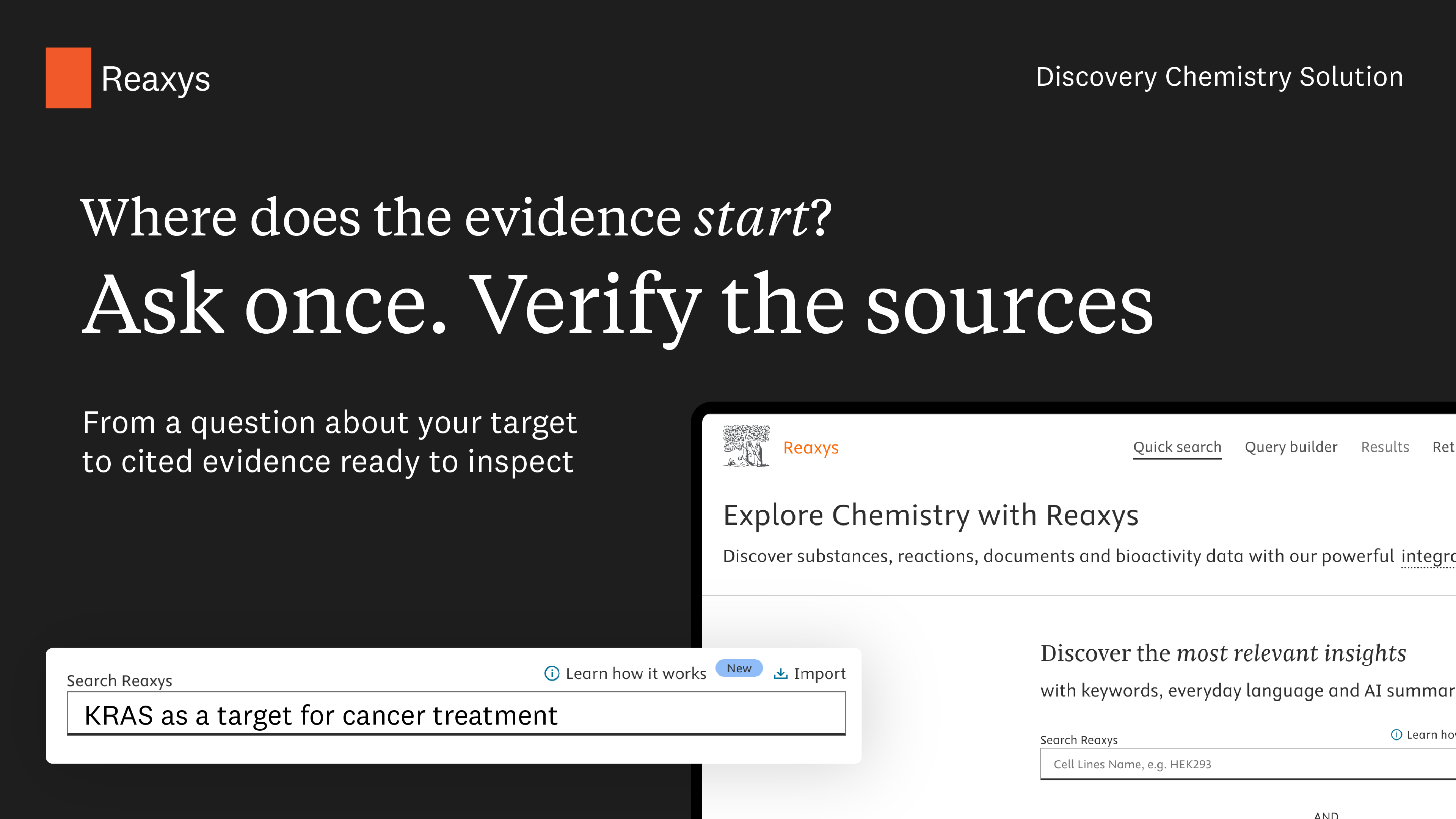
Where does the evidence for a target begin?
With a search that cites its sources
Natural-language search, cited
Ask the question in natural language. Reaxys returns an AI-supported summary built from titles and abstracts of top-ranked papers and patents. Summary claims link to cited references. Open the citation, check the abstract and index terms, then move into the source. Start at the summary for orientation and continue to references for the depth.
Power-user workflows
KRAS target evidence
From target question to cited sources.
Run prompt >
ADC linker/payload chemistry
From literature and patents to connected substances and reactions.
Run prompt >
Patent-aware chemistry evidence
From source records to extracted compounds, reactions and preparation
Run prompt >
A cited foundation for the next workflow.
"Right now, if I need to search for scientific information, I start with Reaxys. The results are consistently relevant and sourced from scientific papers, making it much more reliable than any general search engine."
— Senior Director, Large Pharma (Reaxys AI beta)
Is this target worth advancing?
When literature, patent and bioactivity evidence hold together
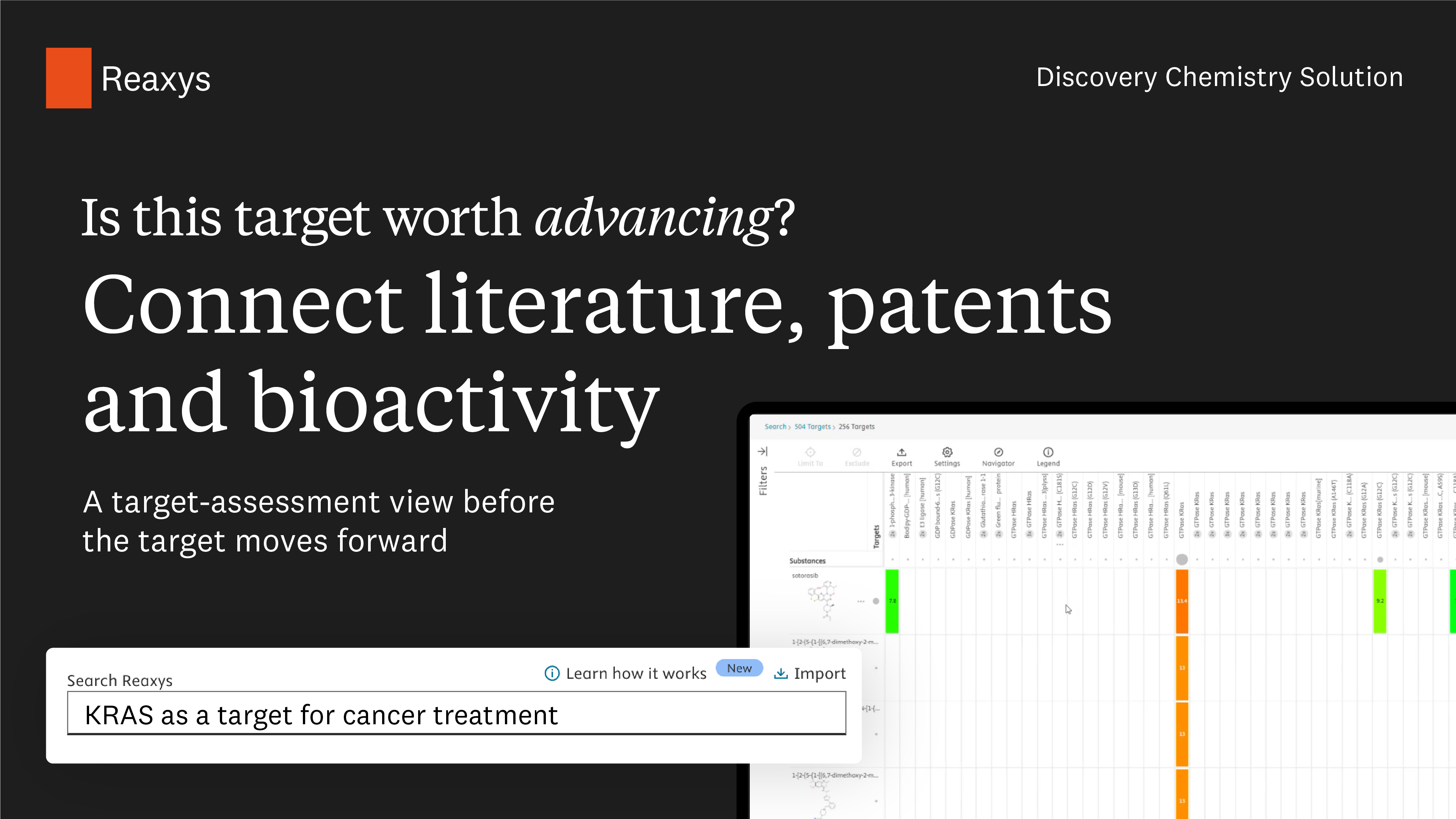
Target evidence in one place
Target assessment suffers when evidence is reviewed in fragments. Bioactivity in one place. Prior art in another. Documents no one has opened. Reaxys brings target evidence together, helping teams review associated compounds and ligands, SAR, patent density, and the supporting documents before a target moves forward.
"Reaxys' depth of indexing has been essential to ensuring completeness and avoiding missed data at the earliest stage of discovery."
— Dr Christine Richardson, Principal Scientist, Sygnature Discovery
Sygnature Discovery accelerates target assessment with Reaxys
Sygnature embeds Reaxys into multidisciplinary workflows to inspect bioactivity and target evidence across literature and patents.
Read the Sygnature case study >
What should we design next?
Start with the scaffold. Then make the evidence argue
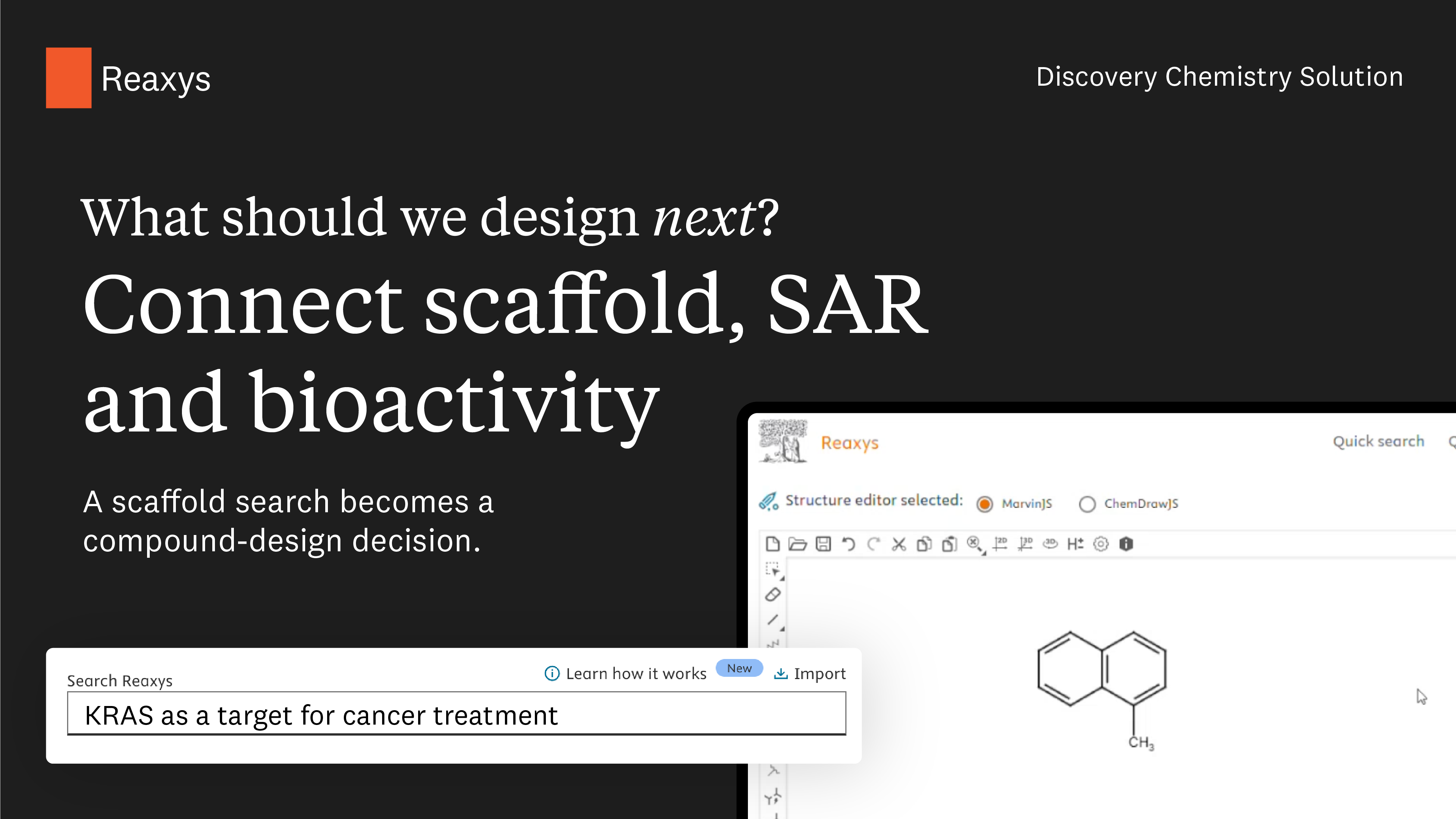
Scaffold, SAR, bioactivity evidence
Draw the scaffold. Pair it with KRAS. Search as a substructure. Then inspect substances, targets, bioactivity, drug-likeness and related, side by side. The next compound should come from evidence that has been compared, not from a hunch dressed as progress.
Structure-activity relationship review for the compound design.
Biotechnology company | Innovation in small molecule discovery
A biotechnology company integrated Reaxys chemistry data into internal datasets and post-processing workflows to support small molecule discovery.
Read the Innovation in small molecule discovery case study >
How can I make it?
A molecule becomes a plan when the route evidence holds
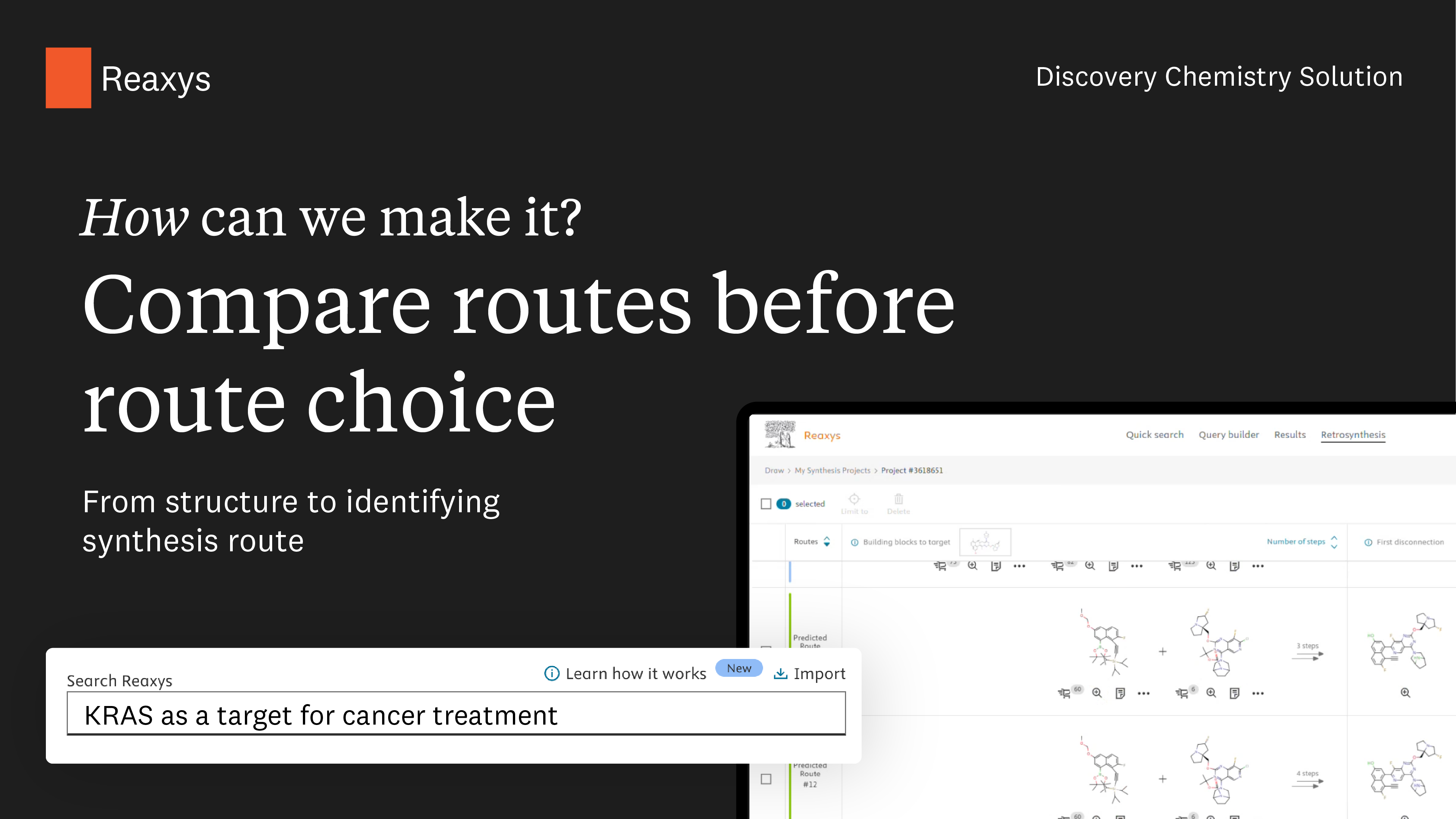
Route evidence before route choice
The route still must answer basic questions: steps, precedents, conditions, starting materials and alternatives. Reaxys retrosynthesis gives chemists the evidence to compare routes before a compound idea becomes a synthesis plan.
A route evidence view before route choice.
NEW IN REAXYS
Your reaction is drawn. What conditions come next?
Start with similar reactions. Keep the evidence in view.
Condition evidence before the next experiment.
A target reaction is only the start. Reaxys Conditions Navigator brings literature-backed condition options from similar Reaxys reactions into one decision-ready view.
Compare reagents, catalysts, solvents, reaction similarity, median yield, supporting examples, functional-group behavior and source references before deciding what deserves closer review.

A condition-evidence view before the next experiment.
A condition-evidence view before the next experiment.
Smarter synthesis routes cut time and costs
Lonza tested Reaxys Predictive Retrosynthesis for route scouting and reported 17% fewer synthesis steps on average.
Is this chemical space available?
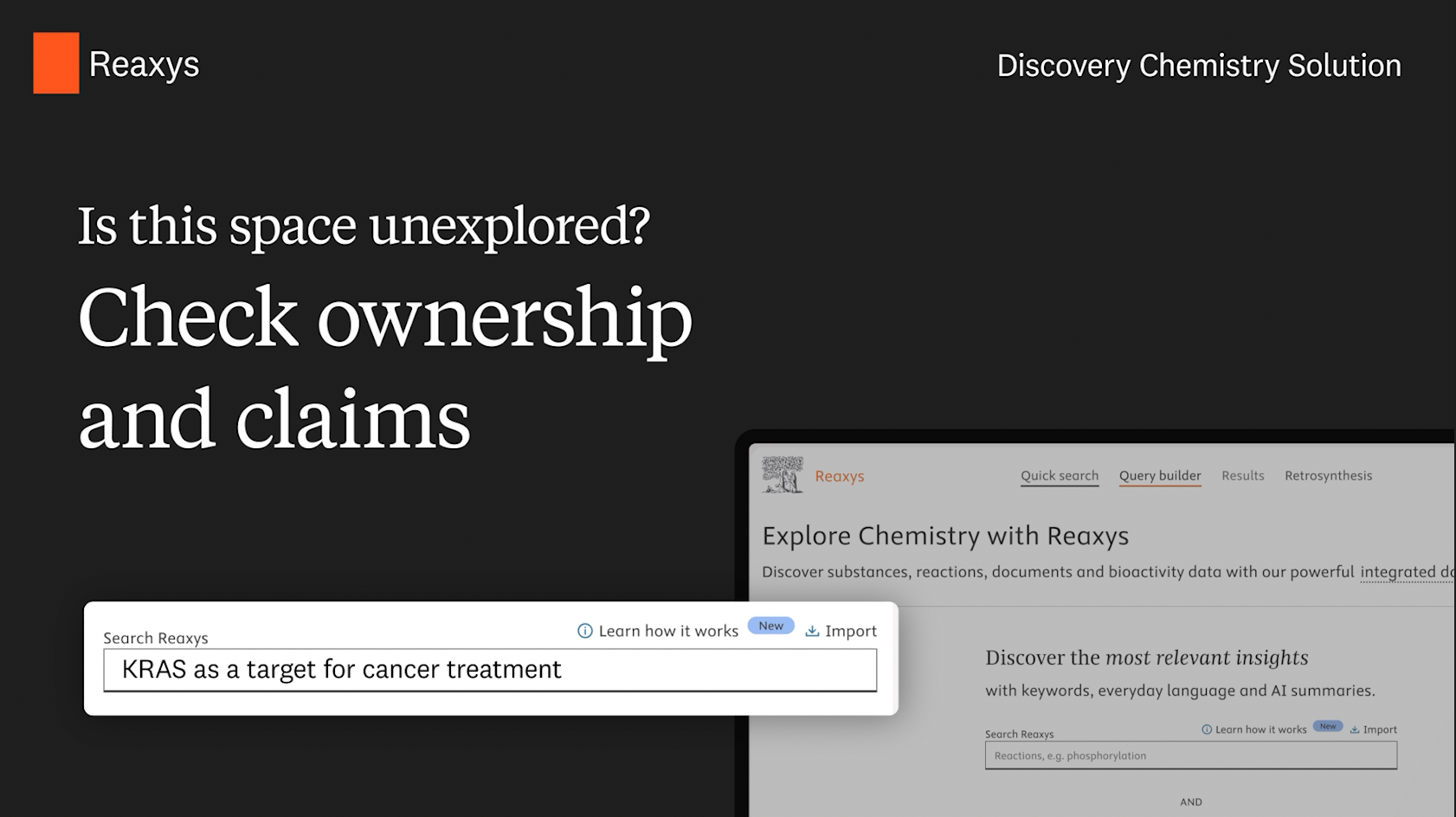
Test it against 50M patents, 105 offices and claims in English
White space, not freedom-to-operate
White space is a chemistry question, not a legal conclusion. Reaxys lets the team inspect patent ownership across substances, reactions and documents — by current assignee, original assignee or ultimate owner — then review the family behind each filing. Legal will rule on freedom to operate later. Chemistry can decide earlier whether the space is worth the design effort.
A whitespace view before the design effort.
FAQs
What does Reaxys AI Search do?
Reaxys AI Search helps users start eligible document searches in natural language and review cited summaries linked to source references.
Should the AI-supported summary be treated as a final answer?
The summary is not the final answer, it is a reviewable starting set that does not replace source review. Chemists should inspect cited references, abstracts and full text where licensed before acting.
Are Reaxys prompts used to train large language models?
The Reaxys prompts are private and are not stored or used to train large language models. Learn more in the Reaxys Reference Guide.
How can Reaxys support target assessment?
Reaxys supports target assessment by connecting target-related compounds, ligands, bioactivity, patents and source documents into the review.
Why does target evidence need patents?
Patent evidence can show prior art, ownership and crowding before a target moves into deeper chemistry investment.
What output should a target review produce?
A target review should produce a decision-ready evidence view that supports advance, pause or redirect.
How can Reaxys support compound design?
Reaxys supports compound design by connecting scaffold and substructure search with substances, targets, bioactivity and SAR evidence.
Why should scaffold design use bioactivity evidence?
Bioactivity evidence helps a chemist compare whether a scaffold direction is supported by measured activity patterns and target context.
What is the design workflow output?
The output is a scaffold and bioactivity evidence view for the next design-make cycle.
How does Reaxys support synthesis planning?
Reaxys supports synthesis planning by helping chemists compare route options, conditions, yields, references and starting-material practicality.
What is the difference between a route idea and route evidence?
A route idea is a possible plan. Route evidence includes precedents, procedures, conditions, yields, references and practical starting materials.
What should chemists inspect before choosing a route?
Chemists should inspect published precedent, route alternatives, conditions, yield, references and starting material availability where available.
What is patent whitespace in discovery chemistry?
Patent whitespace is an early chemistry review of prior art, ownership, claims and family patterns; it is not a legal freedom-to-operate conclusion.
How can Reaxys help with patent review?
Reaxys helps users inspect patent records, claims, assignees, families and alerts across chemistry-related patent evidence.
When should a chemistry team review patent evidence?
A chemistry team should review patent evidence before design effort grows, so crowded or risky spaces can be identified earlier.